Duration
3.10.26, 2:00 PM - 6:00 PM
Language
German, English, Spanish
Admission
Free, limited number of participants, please register via e-mail
Info
Mothering and the more-than-human
A poetic writing session on atmosphere, time and the unseen
Understanding Mothering as an interdependent practice spanning all life forms, this open writing format engages with the multifaceted meaning of Mothering — both in relation to personal, biographical perspectives and planetary entanglements.
In relation to Tomás Saraceno's Spider/Web Cosmologies, interspecies sensing, and atmospheric entanglements, we ask what space Mothering can take today — as a social and political practice, as well as a form of environmental engagement with the world.
Webs form slowly, often invisibly, thread by thread. The spider silk is not merely a passive material or tool, but an active interface through which the spider relates to the world. Over time, spider and silk have evolved together, and today spiders can produce at least seven different types of silk, each specialized for a particular evolutionary purpose. Their becoming follows rhythms other than linear productivity.
What does it mean to think of time as a web? And what can this teach us about mothering and the often invisible, continuous labor of care?
In this context, spider webs become a metaphor for thought and writing: fragile webs of interdependence.
Saraceno's Aerocene opens up a space of thought between body, environment, and future.
Sharing the atmosphere allows us to expand our understanding of the commons — through the first breath, the air that bodies share with one another, and through environmental toxins passed on between generations. This writing format draws on and engages with existing voices who have written on mothering, such as Maternidades Subversivas, Iman Mersal, Rana Issa, Audre Lorde, and others. In the entanglement with words of others, new writing formats emerge exploring what meaning mothering can take on today — what political potential does mothering hold as a social practice?
Please register by email at sangmongkhon@hausderkunst.de
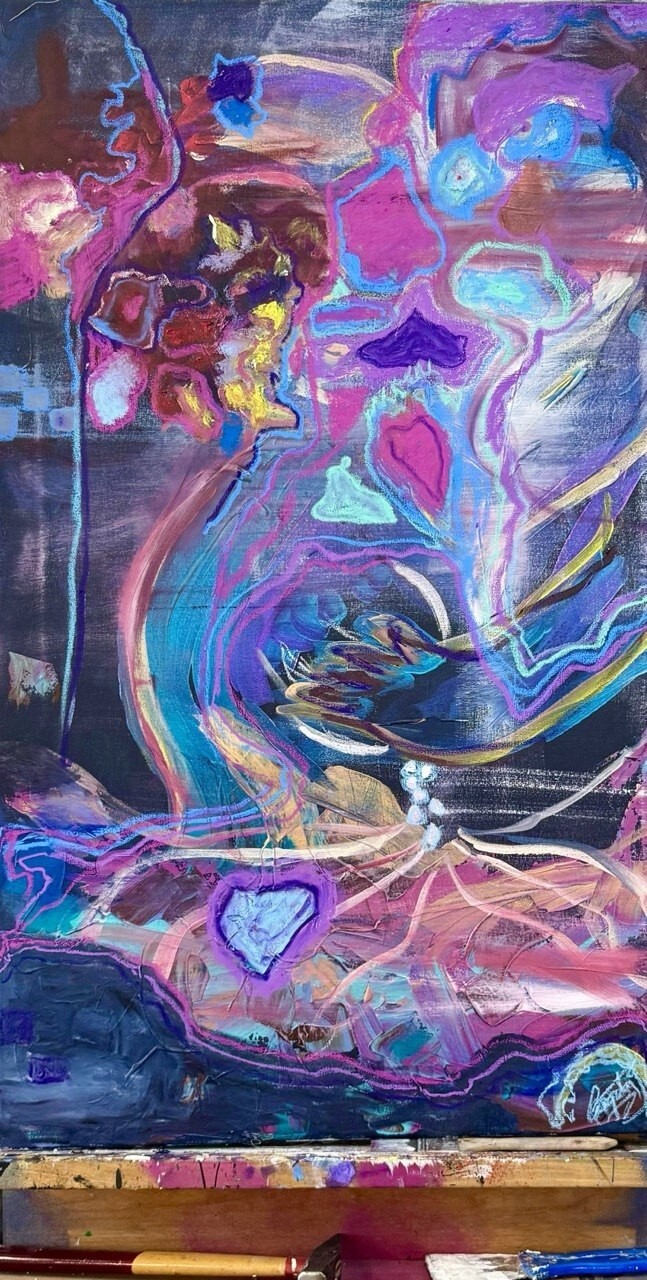
Credit: Çağdaş Çelik-El-Kadi, temas. Photo: Çağdaş Çelik-El-Kadi.
Dr. Carolina Tamayo Rojas is a South American immigrant from Cali, Colombia, with Afro- and Indigenous roots; she is a queer feminist, an anarcho-punk musician, and an activist against racism and racist police violence. As the parent of a 4-year-old child and the eldest daughter of a single mother, she navigates the balance between caregiving, resistance, and knowledge production. She teaches at the Alice Salomon University of Applied Sciences in Berlin on gender, queer theory, empowerment, and power-sharing.
Epona Hamdan is a cultural worker based in Berlin. She works as a producer and researcher for scientific, digital, and media practices at Haus der Kulturen der Welt (HKW), alongside independent curatorial and research-driven projects across artistic and interdisciplinary contexts. Her work spans cosmotechnical inquiry, critical theory, and embodied knowledges, exploring intersections of artistic practice, science and speculative thinking with emerging technologies. She has curated and co-developed programs for Oktoberdans Festival (Bergen), Spore Iniative (Berlin), Free Home University (Lecce) and SPIELART Festival (Munich), as well as independent projects in Berlin and online.
Aadhi Avrina, born in Tamil Nadu in 1992, lives and works in Berlin. He writes about places, entities, and times. Obsessed with memories that both endure and decay, often from childhood, Avrina’s writing ebbs and flows, reflecting his longing for the sea. Avrina’s story won the 2021 Short Fiction / University of Essex International Short Story Prize, and his work has been nominated for the Indiana Review Fiction Prize, the Berlin Writing Prize, the Desperate Literature Short Fiction Prize, and others.
About the Book:
Mothering – Subversive Care as a Radical Practice is both an invitation and a call to action: to place mothering as a political practice at the center of social discourse. For forms of care, sharing, and nurturing are not mere side issues, but subversive, radical practices that society cannot and must not do without. This volume brings together voices that reveal the plurality of mothering—as a lived, resisting, and deeply political practice. Through poems, theoretical reflections, conversations, and images, a polyphonic weaving of experiences of mothering and non-mothering, of care, responsibility, and resistance unfolds. The book draws attention to the often-invisible realities of care and questions the possibilities of conceiving of mothering beyond hegemonic, gendered, and colonially shaped norms. Here, mothering emerges as a form of knowledge transmission and as a counter-epistemic practice that lives on in relationships, gestures, routines, and stories. It is in these interconnections that the potential for transformation lies: the imagination of other futures in which care, relationships, and education become sites of change.