As a globally active public institution, Haus der Kunst regards itself committed to democratic action in collaboration with artists, visitors, and employees. Confronting the history of Haus der Kunst represents a form of a culture of remembrance which needs to be kept alive on both a local and global level, and requires active and critical engagement. Artists and employees who exhibit and work at Haus der Kunst actively participate in this process.
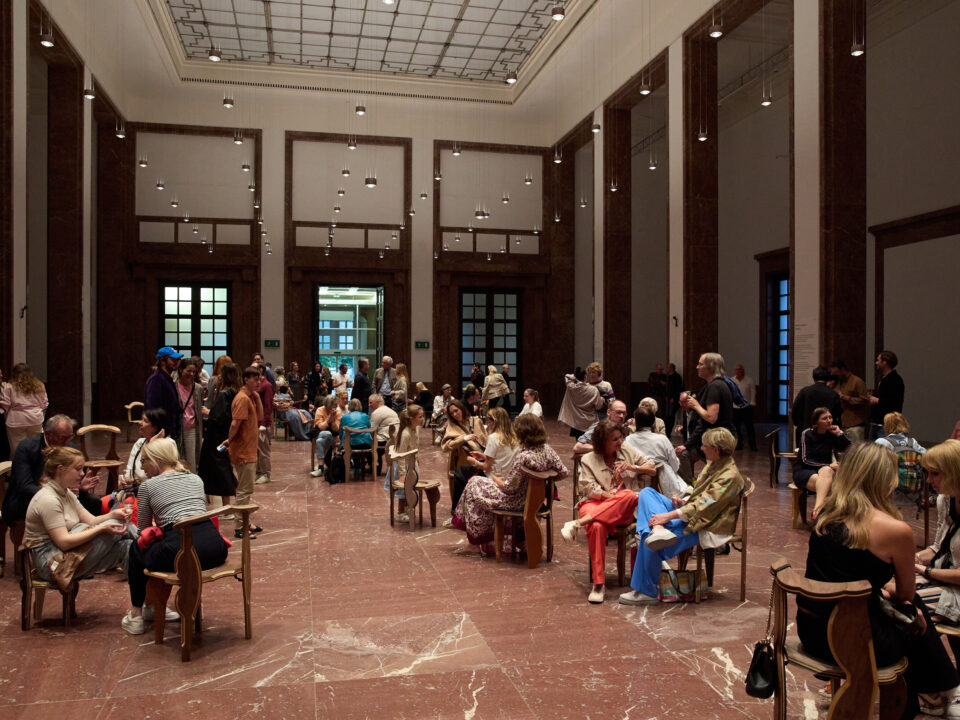
The programme of Haus der Kunst and its working practices are oriented towards creating a place for exchange and respectful coexistence. With the support of artists, cultural workers, and a range of communities, Haus der Kunst is continuously committed to this cause.
Haus der Kunst strives to implement an experimental, transnational, and transdisciplinary programme of the highest quality and relevance, in which different perspectives are included and reflected upon. In this way, Haus der Kunst creates a context critical to recognising and illuminating historical dimensions in the contemporary.
There is no place for ableism, ageism, antisemitism, Islamophobia, othering, queerphobia, racism, sexism, transphobia, or other similar forms of discrimination. Any form of hatred, violence, devaluation, or insult is rejected on all levels at Haus der Kunst.
Haus der Kunst strives to be a place where critical and respectful coexistence is practised on a daily basis. We are committed to a diverse community in which the dignity of every human being is non-negotiable. This applies regardless of age, disability or chronic illness, sex or gender identity, origin, religious beliefs, and sexual orientation. Above all, this means that visitors, artists, and employees are recognised, treated, and valued equally.
Haus der Kunst considers equality and accessibility as core values of a public institution. It thus recognises the complex interrelationships of this reflection and awareness-raising work as an ongoing process.