
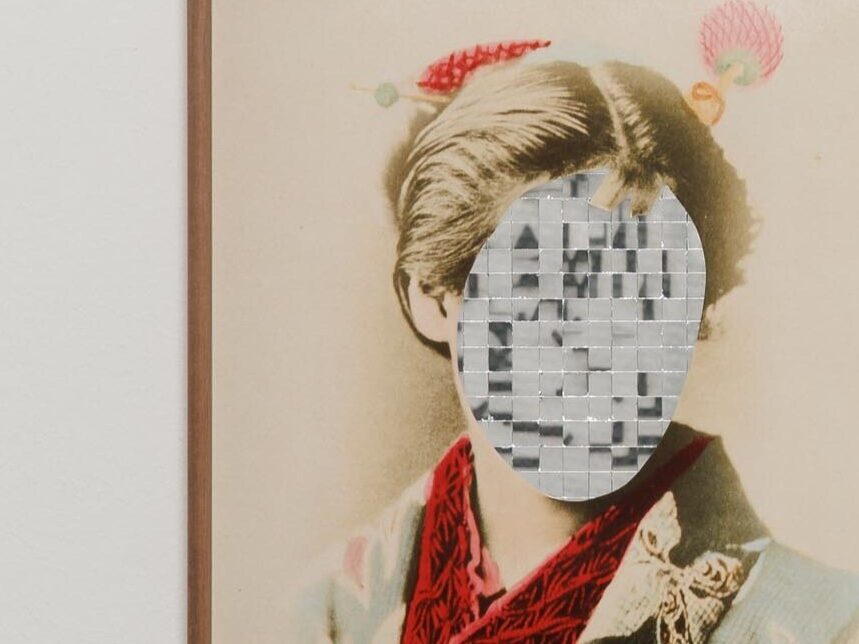
What connects AI-generated images with hand-tinted photographs from the nineteenth century? The artist Lilly Lulay (b. 1985, Frankfurt am Main) traces how visual stereotypes travel across time and technologies, from nineteenth-century Japanese souvenir photographs to today’s image-generating systems.
The starting point for Lulay’s project is a collection of albums containing hand-tinted studio photographs from Japan held in the photography collection of the Münchner Stadtmuseum. Their carefully staged motifs and distinctive pastel colours helped shape European perceptions of Japan. Today, many of these images, now in the public domain, feed into the datasets used to train AI image generators, thereby perpetuating historical clichés in contemporary visual culture.
Through sculptures, collages, metalwork and textiles, Lulay examines how images are classified, circulated, transformed and misinterpreted. Historical captions such as ‘samurai’ reappear as contemporary search terms and prompts, while glitches and errors produced by machine vision become material for new artworks. For example, a hibachi stove, misread by an AI application as a small table, returns as a physical object in the exhibition. Through these translations, Lulay reveals how inherited visual conventions are reproduced and how digital misinterpretations take on a material form.Lulay’s project was developed as part of the Münchner Stadtmuseum’s ‘Artists on Photography’ programme, which invites artists and researchers to engage with its photography collection from contemporary perspectives, opening historical archives to new readings and interpretations.
Curated by Dr. Kathrin Schönegg.
This exhibition by the Münchner Stadtmuseum Photography Collection is part of the “Artists on Photography” fellowship programme, produced in collaboration with Haus der Kunst München. "Artists on Photography" is an initiative offered by Münchner Stadtmuseum. The 2025/26 project is made possible by the Alexander Tutsek-Stiftung.