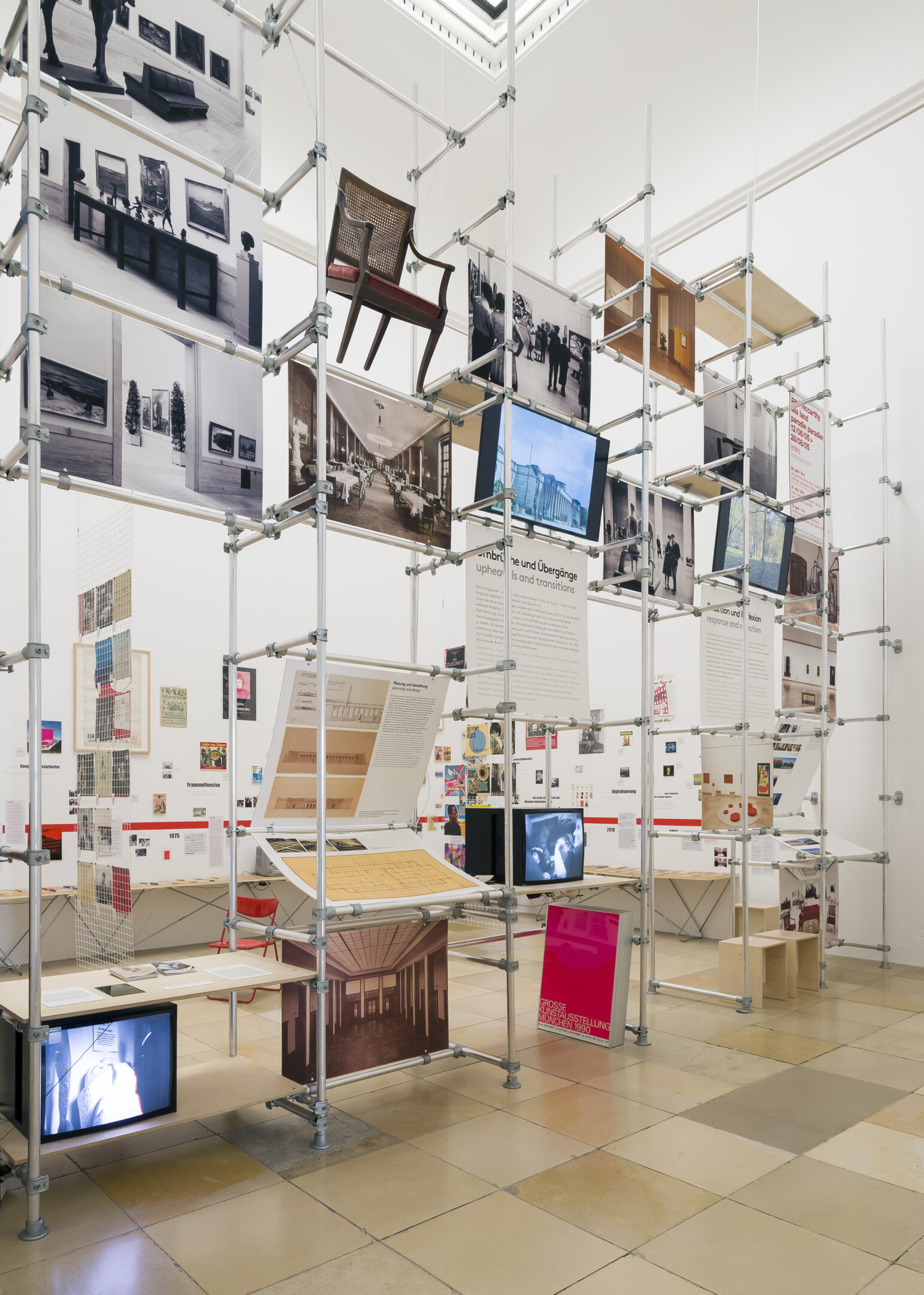
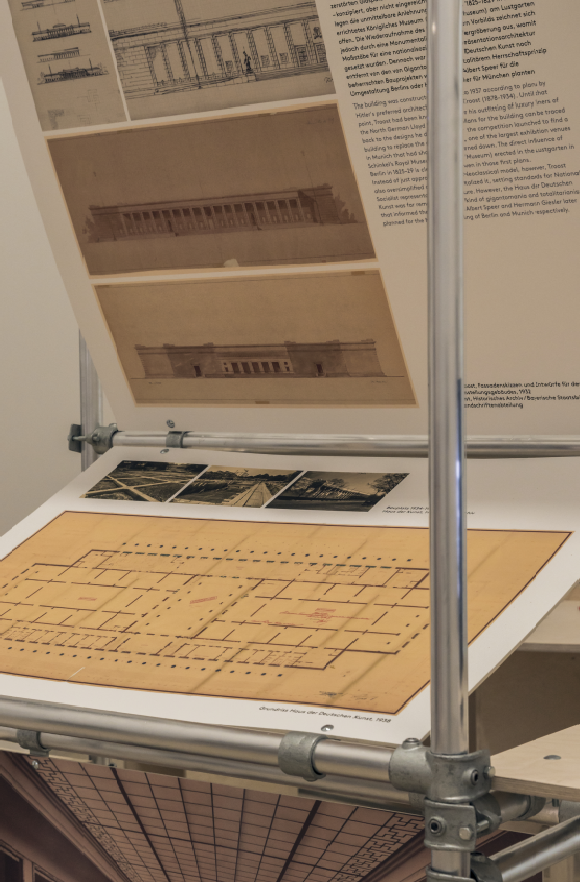
Ground floor plan of "House of German Art", 1938/46
After the collapse of the Third Reich, the American military government seized the "House of German Art" and used it as an Officers’ Club. The sketched-in annotations on the floor plan cannot be dated before May 1946. At this time the east wing was made available for the "Bavarian Export Show"; works from the war-torn Pinakothek art galleries were shown in part of the west wing.
Painting "Sinkende Nacht” by Rudolf H. Eisenmenger, ca. 1936
The painting – an allegorical depiction of the three stages of life – was exhibited in 1937 at the first "Great German Art Exhibition". Eisenmenger was a member of the "artists' jury", which was responsible for selecting works for the inaugural exhibition; this jury, however, was dissolved by Hitler in June 1937 after he previewed the "Great German Art Exhibition".
Catalogue “Der Blaue Reiter”, 1949
The show “Der Blaue Reiter”, which opened in September 1949, was the first in a series of exhibitions that characterized Haus der Kunst on its path to Modernism. “With this commemorative exhibition, which also attracted considerable international attention, the former ‘House of German Art’ was denazified”, noted the former Secretary of State Dieter Sattler in his opening speech.
Design by Max Ott for the former “Hall of Honor”
In the 1950s, Haus der Kunst underwent structural changes that both allowed for multiple uses and rid the building of unwelcome reminders of its heritage. A competition was held for this purpose in 1956. The design submitted by Max Ott, which was never realized, proposed turning the former “Hall of Honor” into a “lobby.”
Poster “Venetian Night”, 1955
Starting in 1949, thanks to the swing of bandleaders like Max Greger and Hugo Strasser, Haus der Kunst began hosting legendary carnival celebrations and became Munich’s carnival stronghold for 25 years. With large installations and paintings, Munich artists transformed the marble halls into wild landscapes, palaces, and dive bars. They took over the history-laden building in their own way.
Promotional leaflet, 1938
From the time the “House of German Art” opened in 1937, promotional material was used to popularize the building and the “Great German Art Exhibitions”. The leaflet shows some of the exhibited works. Its reverse side advertises the institution’s dining facilities: a large café-restaurant (now the Terrace Hall), today’s Golden Bar, and the rustic beer parlor.
Advertising card for tennis courts, undated
The Officers’ Club in Haus der Kunst offered American GIs not only bars and restaurants, but also a variety of sports facilities. Makeshift basketball courts were installed in the major exhibition halls, and tennis courts were installed behind the building. On the north side of Haus der Kunst, these courts remained in use even after the Officers’ Club departed.
Drink list, undated
The drink list is one of the few remaining documents created directly after the war, when the American military used the Haus der Kunst to house an officers’ club.
North facade of “House of German Architecture”, with design by Leonhard Gall, undated
In 1938, Adolf Hitler announced the construction of a “House of German Architecture”, which was to be located opposite the “House of German Art”. Prinzregentenstraße would thus become an avenue of the arts. Like most of the National Socialist’s major building projects, this building was never constructed.
A report on hanging and placement of the works in the “Great German Art Exhibition”, 1940
The report is the only document so far that provides information on the hanging practice – and Adolf Hitler’s significant involvement in the selection – of exhibits for the “Great German Art Exhibitions”. The report was created on July 23, 1940, four days before the fourth “Great German Art Exhibition” opened.
Deposit Ledger for Paintings, 1941-44
More than 7,000 works were sold at the "Great German Art Exhibitions" staged annually from 1937 to 1944/45 in the “Haus der Deutschen Kunst” [House of German Art]. A "Deposit Ledger for Paintings" lists 827 oil paintings bought by Adolf Hitler and successively transferred in early 1944 to the Munich "Führerbau" and to the Altaussee salt mines, where the spoils of Nazi art theft were located.
Express letter from the Reich Ministry for Public Education and Propaganda, Feb. 5, 1945
In order to stage the "Great German Art Exhibitions" in grand style even during the war years, Adolf Hitler exempted all employees working at the "House of German Art" from serving in the Wehrmacht and war-related organizations. In February 1945, even as Germany lay in ruins, Hitler ordered preparations for another "Great German Art Exhibition".