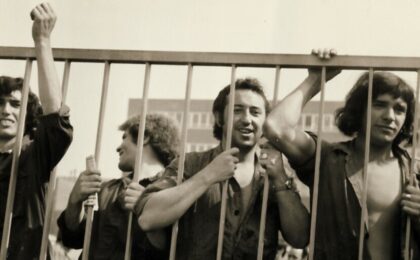
Paul Ludwig Troost and Adolf Hitler in front of a model of the "Haus der Deutschen Kunst", 1933
Bavarian State Library, Munich / Hoffmann Photo Archive

Paul Ludwig Troost, plans for the facade of the "Haus der Deutschen Kunst", March 25, 1933
Bavarian State Library, Munich

"Haus der Deutschen Kunst" 
[House of German art]

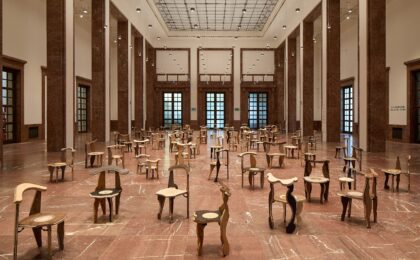
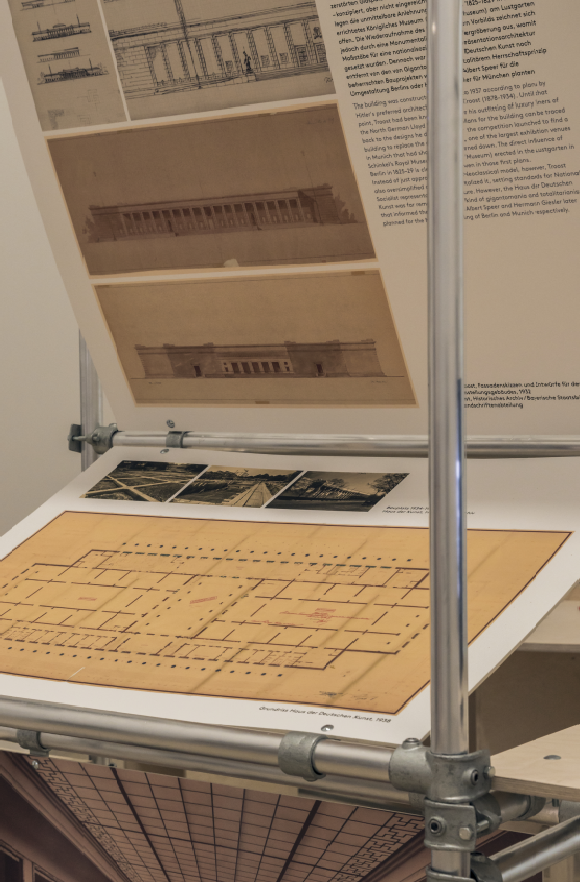
The Bavarian Ministry of Culture planned a new building made of stone for exhibitions as the successor to the Glass Palace. It put architect Adolf Abel from the Technical College in charge, whose plans were about to be implemented in early 1933. After the National Socialists had come to power, Hitler relocated the building plot to the southern edge of the "Englischer Garten," Munich's large park. It was on his orders that Paul Ludwig Troost, who had never worked for the state before, was given the contract for the first representational monumental building of the Third Reich, the "Haus der Deutschen Kunst"(House of German Art). Until that point, Troost had been known mainly for his outfitting of the luxury liners of the North German Lloyd line and for a variety of representative furniture collections that he had designed for the Vereinigten Werkstätten. After his early death in January 1934, he was elevated to "First Master Builder to the Führer." His widow, Gerdy Troost, and his trusted employee, Leonhard Gall, continued the work without making any significant changes to the plans. Troost's neo-classical art shrine, which includes references to Klenze and Schinkel, consisted of a modern steel structure clad in natural stone and containing some innovative engineering. An air-raid shelter was included in the basement. Top officials from Germany's economic and industrial sectors made significant donations to finance the 9 million Reichsmark it cost to build this trophy building. In 1938, Hitler ordered construction of the "House of German Architecture," an exhibition space for architecture and applied arts. It was designed by Leonhard Gall and was to be located facing the "Haus der Deutschen Kunst."  But like most of the large-scale Nazi projects, these plans were never implemented.

→ Sources /contemporary reports

Timeline

1933

January 30 Hindenburg names Adolf Hitler Chancellor of the Reich.

February 27 the Reichstag fire; freedom of expression, the press and public gatherings is curtailed by the "Decree on the protection of the people and the state"

March 20 Heinrich Himmler sets up the first "regular" concentration camp in Dachau, near Munich

April 1 Jewish shops, doctors and lawyers are boycotted

April 7 "Law to restore career officials"; officials who are Jewish or critical of the regime are prohibited from working

April First "Exhibition of Shame" to defame modern art held in Karlsruhe and Mannheim.

May 10 Book-burnings are held in many German university towns.

July 15 Four-power pact to safeguard peace policies is signed by the German Reich, France, Great Britain and Italy.

Timeline

1933

January 30 Hindenburg names Adolf Hitler Chancellor of the Reich.

February 27 the Reichstag fire; freedom of expression, the press and public gatherings is curtailed by the "Decree on the protection of the people and the state"

MORE ...

###OVERLAY_VIDEO###